
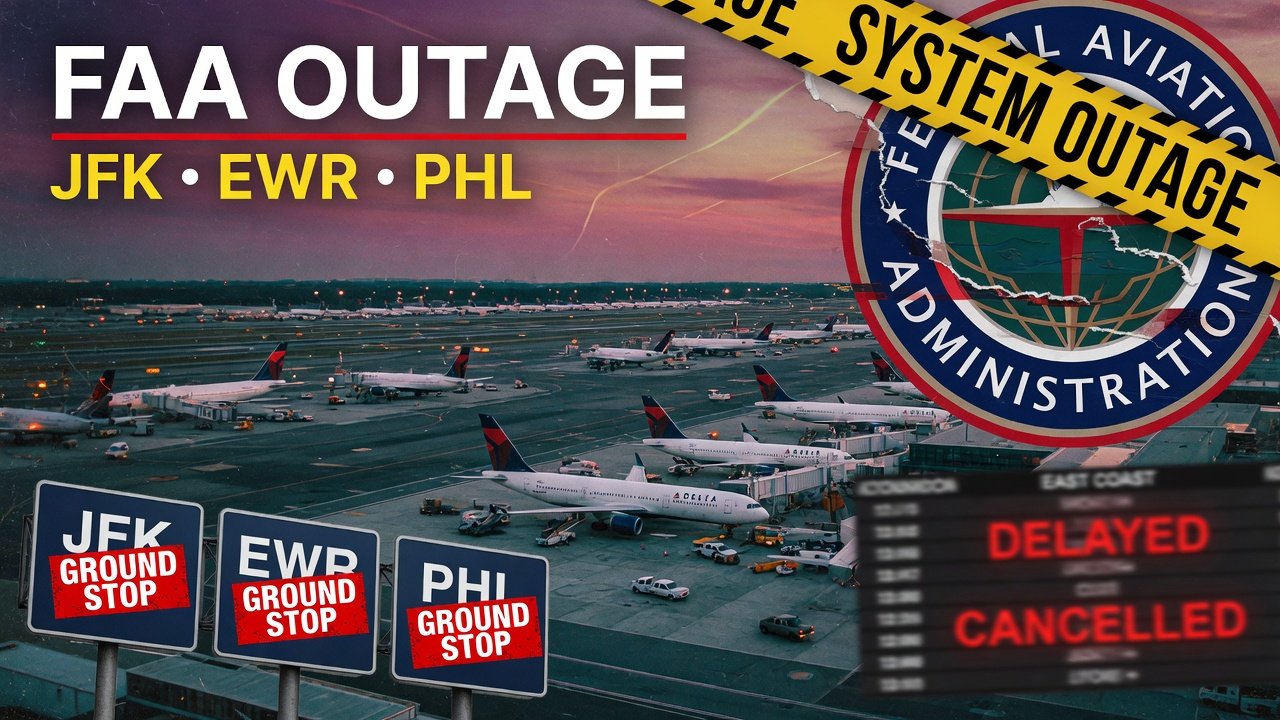
FAA Outage Disrupts East Coast Flights, Ground Stops Hit JFK, Newark and Philadelphia
A major FAA outage disrupted air travel across the US Northeast after a communications and equipment failure at a key Federal Aviation Administration air traffic control facility affected the movement of commercial aircraft.
The disruption on September 21 forced the FAA to impose ground stops and other traffic restrictions at several major airports, including Newark Liberty International Airport, Philadelphia International Airport, John F. Kennedy International Airport and LaGuardia Airport. Boston was also affected by the wider disruption.
The incident caused widespread delays, cancellations and diversions across the region, with knock-on effects spreading to other airports and airline networks.
FAA Outage Triggers Ground Stops Across Northeast
The disruption originated around the Philadelphia air traffic control system after a primary communications connection failed. The situation was compounded when a backup fiber-optic line was accidentally severed during construction work in New Jersey.
The loss of both communication paths affected the FAA’s ability to maintain normal radar and radio communications at the Philadelphia Terminal Radar Approach Control facility, commonly known as Philadelphia TRACON.
With critical communications capabilities compromised, the FAA imposed restrictions on incoming flights to manage traffic safely.
FAA operational advisories showed that equipment problems persisted at Philadelphia TRACON during the disruption, while arrivals at Philadelphia resumed only at limited capacity before operations gradually returned to normal.
JFK, Newark and Philadelphia Among Airports Affected
Some of the busiest airports in the Northeast were directly affected by the FAA outage.
The disruptions included:
- Newark Liberty International Airport (EWR)
- John F. Kennedy International Airport (JFK)
- LaGuardia Airport (LGA)
- Philadelphia International Airport (PHL)
- Boston-area airports
- Other airports affected by diversions and network disruptions
Newark experienced particularly severe disruption, with more than 600 cancellations reported during the incident. JFK and LaGuardia were also heavily affected.
FAA advisories also indicated that a ground stop at Philadelphia was followed by a low-rate ground delay program, while a separate delay program was implemented for JFK.
Thousands of Flights Delayed or Canceled
The outage quickly developed into a nationwide airline scheduling problem because aircraft and crews were displaced from their planned locations.
According to Reuters, approximately 7,000 flights were delayed or canceled across the United States by the end of September 21, with more than 1,400 disruptions concentrated at the major New York-area airports.
The impact extended beyond the airports directly affected by the FAA restrictions.
When an aircraft cannot arrive at its scheduled destination, subsequent flights involving the same aircraft and crew can also be delayed or canceled. This creates a cascading effect across airline networks.
Passengers therefore continued to experience delays even after FAA operations began returning toward normal.
What Caused the FAA Outage?
The disruption was linked to failures involving the communications infrastructure supporting the Philadelphia air traffic control facility.
According to reporting by Reuters and other outlets, the primary communications circuit failed and a backup fiber-optic line was accidentally cut during construction work in New Jersey.
The backup line was reportedly part of the telecommunications infrastructure used to maintain communications when the primary connection was unavailable.
Once the backup connection was also compromised, the FAA faced a significant reduction in its ability to communicate with aircraft operating in the affected airspace.
The telecommunications lines were subsequently repaired, allowing normal operations to resume gradually.
FAA Says Operations Have Resumed
The FAA and transportation officials worked with telecommunications providers and local authorities to restore the affected infrastructure.
By Monday evening, operations at the impacted airports were returning toward normal, although residual delays continued as airlines worked through the backlog created by the disruption.
FAA airport status pages later showed Newark and Philadelphia operating with relatively limited general delays, although passengers were still advised to check directly with their airlines because airport-level status information does not necessarily reflect individual flight conditions.
Aging Air Traffic Infrastructure Under Scrutiny
The outage has renewed attention on the condition of the US air traffic control system and the importance of redundant communications infrastructure.
Transportation Secretary Sean Duffy and FAA Administrator Bryan Bedford have highlighted the need to modernize aging aviation infrastructure following the incident. Reuters reported that Congress had previously allocated $12.5 billion for air traffic control upgrades, while Duffy has called for an additional $17.5 billion in funding.
The incident also highlighted how the failure of multiple communications pathways can affect a large section of the national aviation network.
Because major Northeast airports operate in closely connected airspace, disruptions at one major air traffic control facility can quickly affect airports hundreds of miles away.
UN General Assembly Adds to Travel Pressure
The outage occurred during the United Nations General Assembly in New York, when the region was already experiencing significant international travel activity.
The timing increased the number of travelers moving through New York-area airports, adding another layer of pressure to an already disrupted aviation network.
Airlines responded with flight changes and, in some cases, travel waivers for affected passengers.
Travelers were advised to check their individual flight status with their airline before heading to the airport.
What Happens Next?
The immediate priority is clearing the backlog of delayed and canceled flights and restoring normal aircraft and crew schedules.
Although the telecommunications problem has been repaired, airlines may need additional time to reposition aircraft, crews and passengers.
The FAA will also need to examine the incident and determine whether additional safeguards are required to prevent a similar communications failure from creating widespread restrictions.
The outage is likely to add urgency to ongoing efforts to modernize US air traffic control infrastructure and strengthen backup systems.
Looking Ahead
The FAA outage demonstrated how a failure involving communications infrastructure at a single critical air traffic facility can create significant consequences for airports and airlines across the Northeast.
JFK, Newark, Philadelphia and other major airports experienced ground stops, delays, cancellations and diversions as the FAA managed traffic during the communications failure.
Operations have since resumed, but the disruption has highlighted vulnerabilities in the country’s aging air traffic control infrastructure.
For passengers, the immediate focus remains checking individual flight status updates, while for aviation authorities, the incident adds another reason to prioritize reliable communications, redundancy and modernization across the national air traffic system.
Frequently Asked Questions
1. What caused the FAA outage?
The disruption was linked to a failure of a primary communications circuit at the Philadelphia air traffic control facility, compounded by an accidentally severed backup fiber-optic line.
2. Which airports were affected by the FAA outage?
Major affected airports included Newark, JFK, LaGuardia and Philadelphia, with disruptions also affecting Boston and other airports through diversions and network delays.
3. Were flights at JFK canceled?
Yes. JFK experienced significant delays and cancellations as FAA restrictions affected air traffic across the New York region.
4. Was Newark Airport affected?
Yes. Newark Liberty International Airport was among the airports most heavily affected, with more than 600 cancellations reported during the disruption.
5. Was Philadelphia Airport affected?
Yes. Philadelphia International Airport was directly affected because the communications failure occurred at the Philadelphia TRACON facility. FAA advisories reported limited arrival operations during the disruption.
6. How many flights were disrupted?
Reuters reported that approximately 7,000 flights across the United States were delayed or canceled by the end of September 21, with more than 1,400 disruptions at major New York-area airports.
7. Did the FAA restore operations?
Yes. Repairs allowed operations to resume later on September 21, although airlines continued dealing with residual delays and cancellations.
8. What is Philadelphia TRACON?
Philadelphia TRACON is an FAA air traffic control facility responsible for managing aircraft operating in the terminal airspace around Philadelphia and surrounding areas.
9. Why did the outage affect so many airports?
Major Northeast airports share interconnected airspace and depend on coordinated air traffic control. Restrictions at one critical facility can therefore cause delays, diversions and ground stops across multiple airports.
10. What should passengers do if their flight is affected?
Passengers should check their flight status directly with their airline before traveling to the airport and monitor the airline’s latest rebooking or travel-waiver information.
