
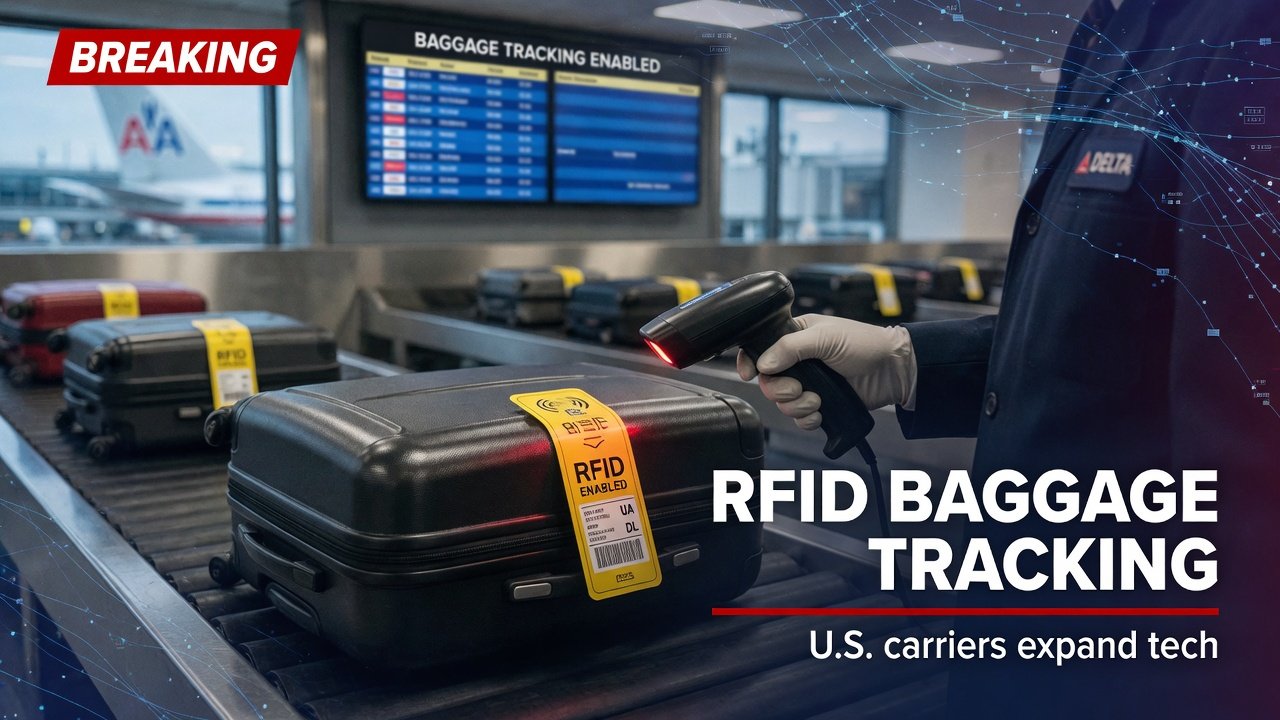
Airline Baggage Tracking Initiative: RFID Technology Reshapes US Baggage Handling
Airline Baggage Tracking Initiative efforts are gaining momentum as airlines, airports and technology providers expand RFID-based baggage tracking and standardized data-sharing systems designed to make checked luggage easier to monitor throughout the journey.
Although there is no verified announcement of a single new framework requiring every major U.S. airline to deploy interoperable RFID systems across all domestic hubs by the end of 2026, the underlying technology push is real. Airlines and airports are increasingly investing in RFID, automated baggage handling and digital data exchange to improve visibility and reduce mishandled luggage.
Why RFID Is Becoming Important for Airline Baggage
Traditional baggage tracking has relied heavily on barcode scanning. While barcodes remain widely used, they require a scanner to have a relatively clear view of the printed code.
RFID, or Radio Frequency Identification, works differently. RFID readers can identify tagged baggage without requiring the same direct line of sight. This allows multiple bags to be identified as they move through baggage-handling systems.
The technology can provide airlines and airports with more detailed information about where a bag is during different stages of its journey, from check-in and sorting to aircraft loading and arrival.
That additional visibility can help operational teams identify problems earlier and potentially reduce the number of bags that become delayed or misrouted.
IATA Standards Are Driving Baggage Tracking
A major foundation for modern baggage tracking is IATA Resolution 753, which requires baggage tracking at important points during the passenger journey.
The framework covers tracking when baggage is accepted from the passenger, loaded onto the aircraft, transferred between flights or airlines, and delivered at the destination.
Importantly, Resolution 753 does not mean every airline must use RFID exclusively. Airlines can use different technologies to collect the required tracking information.
RFID is nevertheless becoming an important option because of its ability to automate identification and provide more reliable tracking data.
IATA has also been developing standardized baggage information exchange systems. The newer Baggage Information Exchange approach is designed to make baggage data more structured and interoperable between airlines, airports, ground handlers and technology providers.
US Airports Are Already Deploying RFID Systems
The move toward smarter baggage handling is not merely theoretical.
One recent example is Gerald R. Ford International Airport in Michigan. Its newly expanded baggage system uses RFID-enabled totes to transport checked luggage through the screening process. The system is designed to improve baggage tracking, reliability and throughput.
The airport began introducing self-service bag check capabilities in September 2026 for passengers traveling on American Airlines, United Airlines and Frontier Airlines. Other carriers are expected to transition to the system in later phases.
This illustrates how RFID adoption can occur at the airport infrastructure level rather than through a single nationwide airline mandate.
What RFID Baggage Tracking Could Mean for Passengers
For passengers, the biggest potential benefit is improved visibility.
Instead of discovering that a bag has been delayed only after reaching the baggage carousel, better tracking infrastructure can allow airlines to know where the luggage was last recorded.
Depending on the airline’s passenger-facing technology, tracking information can potentially be displayed through mobile applications or other digital services.
A more connected system can also help airline employees locate bags faster when something goes wrong.
For connecting passengers, this becomes particularly important because baggage may move between different aircraft, terminals, airports, ground handlers and even airline partners.
Better Tracking Could Reduce Mishandled Baggage
Baggage mishandling remains a significant operational and financial issue for the aviation industry.
SITA’s 2026 baggage research highlighted the continuing cost of mishandled luggage, while also reporting progress in baggage tracking and handling. The industry is increasingly combining tracking technology with automation, data analytics and digital baggage-management systems.
RFID cannot eliminate every baggage problem. Bags can still be delayed because of missed connections, flight disruptions, security procedures, weather or operational issues.
However, better tracking can make those problems easier to identify and resolve.
Interoperability Is the Bigger Challenge
One of the most important issues is not simply installing RFID readers.
Airlines, airports and ground handlers often operate different baggage-management systems. A truly connected baggage ecosystem requires those systems to exchange information reliably.
That is why standardized data formats and messaging systems are becoming increasingly important.
IATA’s Baggage Information Exchange initiative is designed to create a more consistent way of sharing baggage information between multiple participants in the aviation ecosystem.
This could become particularly valuable for journeys involving multiple airlines.
For example, if a passenger flies from one U.S. city to another with a connection involving two carriers, baggage information needs to move between systems without creating gaps in the tracking record.
Airlines Are Taking Different Approaches
Another important point is that RFID adoption is not happening identically across the airline industry.
Some carriers have invested heavily in RFID infrastructure, while others rely on combinations of barcode scanning, RFID and other tracking technologies.
IATA’s implementation guidance recognizes several different approaches depending on an airline’s network, hubs, partnerships and existing infrastructure.
That makes a single nationwide implementation deadline difficult to establish.
Instead, baggage modernization is developing through a combination of airline investments, airport upgrades, industry standards and technology partnerships.
The Role of Smart Airports
RFID baggage tracking is also part of a larger transformation taking place inside airports.
Modern baggage systems increasingly combine RFID with:
- Automated sorting
- Computer vision
- Artificial intelligence
- Self-service bag drops
- Real-time operational dashboards
- Digital baggage messaging
- Automated screening systems
- Passenger-facing baggage notifications
The goal is to move from a baggage system that simply records where a bag was scanned to one that can provide a near-real-time picture of the entire baggage journey.
What Comes Next for Airline Baggage Tracking?
The next phase of baggage modernization is likely to focus on data interoperability as much as physical tracking hardware.
RFID readers and tags provide the data, but standardized systems are needed to make that information useful across different organizations.
As more airports install automated baggage infrastructure and airlines improve their digital systems, passengers could see more detailed baggage-status information and faster recovery when luggage is delayed.
The broader industry trend is therefore moving toward connected baggage ecosystems rather than isolated airline tracking systems.
Frequently Asked Questions
What is the Airline Baggage Tracking Initiative?
The term refers broadly to industry efforts to improve baggage visibility through technologies such as RFID, automated handling systems and standardized baggage-data exchange. There is not currently verified evidence of one new U.S.-wide airline framework requiring every major carrier to implement RFID across all domestic hubs by the end of 2026.
What is RFID baggage tracking?
RFID baggage tracking uses radio-frequency identification tags and readers to identify and monitor luggage as it moves through an airport. Unlike traditional barcode scanning, RFID does not require the same direct line of sight between the tag and reader.
Do all US airlines use RFID for baggage?
No. RFID adoption varies between airlines and airports. Some have made significant investments in RFID infrastructure, while others use a combination of RFID, barcode and other baggage-tracking technologies.
What is IATA Resolution 753?
IATA Resolution 753 is an industry requirement for baggage tracking at key points in the baggage journey, including acceptance, loading, transfer and delivery. It does not require airlines to use RFID exclusively.
Can RFID prevent lost luggage?
RFID cannot guarantee that luggage will never be lost or delayed. However, more accurate tracking can help airlines identify where a bag was last recorded and improve the process of locating and recovering mishandled baggage.
Will passengers be able to track their bags in real time?
That depends on the airline’s passenger-facing technology. RFID and standardized baggage data can provide the underlying information, but airlines must integrate that information into their websites, mobile apps or other passenger services.
Why is interoperability important for baggage tracking?
Interoperability allows different airlines, airports, ground handlers and baggage systems to exchange information. This is particularly important when a passenger’s journey involves multiple carriers or connecting airports.
Is RFID baggage tracking the future of airline travel?
RFID is likely to remain an important part of modern baggage handling, but the future will involve more than RFID alone. Automated sorting, artificial intelligence, computer vision, standardized data exchange and real-time passenger notifications are all expected to contribute to smarter baggage operations.
