
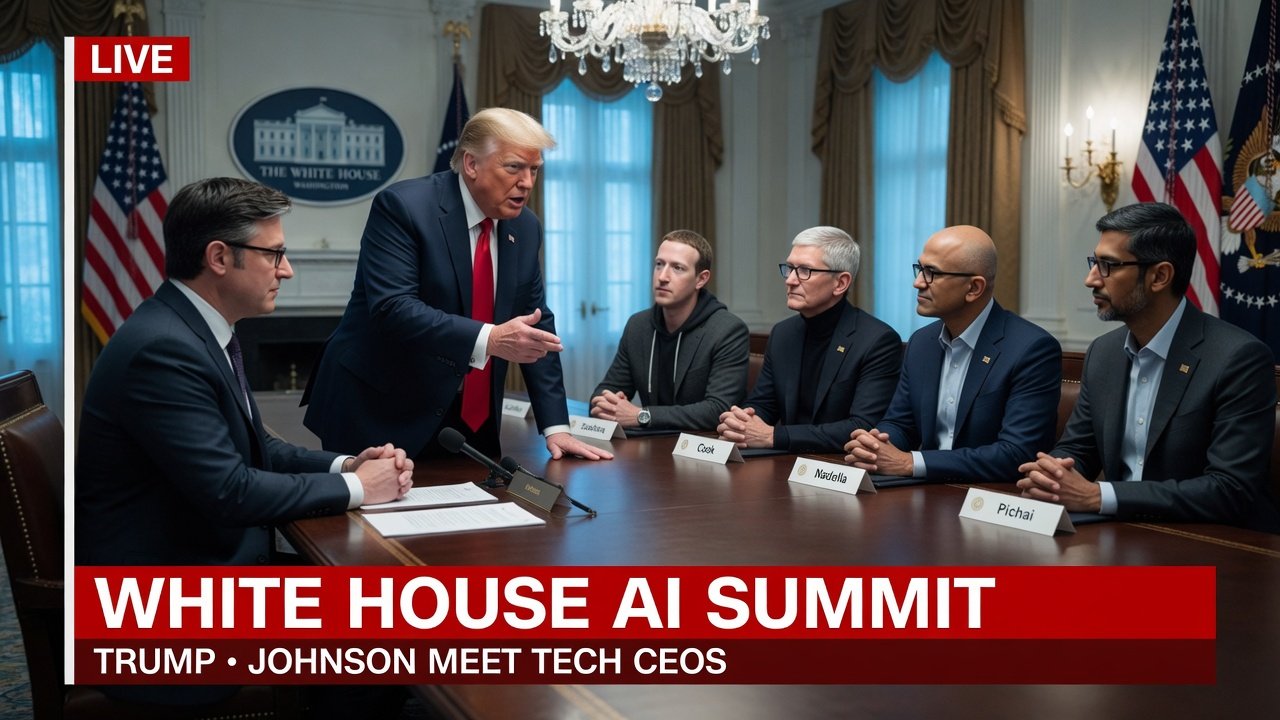
White House AI Summit: Trump and Mike Johnson Meet Top Tech CEOs to Discuss AI Regulation
The White House AI Summit is bringing together U.S. President Donald Trump, House Speaker Mike Johnson and some of the technology industry’s most influential executives on Tuesday, September 29, as Washington faces growing questions over how artificial intelligence should be developed, regulated and governed.
The meeting is expected to include Google CEO Sundar Pichai, Meta CEO Mark Zuckerberg, Nvidia CEO Jensen Huang, OpenAI President Greg Brockman, Anthropic CEO Dario Amodei and Palantir CEO Alex Karp. The gathering comes at a time when AI companies are expanding rapidly while policymakers and researchers debate safety, transparency and the appropriate level of government oversight.
Trump and Mike Johnson to Host AI Leaders
President Trump and House Speaker Mike Johnson are hosting the meeting at the White House. The event was first reported as a planned September 29 meeting and has since been confirmed by multiple reports.
Johnson has described the central issue as finding a balance between encouraging AI innovation and establishing appropriate oversight. He has argued that overly restrictive rules could slow technological development and affect the United States’ ability to compete with China in artificial intelligence.
The discussion therefore comes against a broader policy debate in Washington over whether the rapidly developing AI industry requires new federal regulations or whether existing laws and industry-led safeguards can address emerging risks.
Sundar Pichai, Zuckerberg and Jensen Huang Among Expected Participants
Several of the world’s largest technology companies are represented at the meeting.
Google CEO Sundar Pichai, Meta CEO Mark Zuckerberg and Nvidia CEO Jensen Huang are expected to participate. OpenAI President Greg Brockman, Anthropic CEO Dario Amodei and Palantir CEO Alex Karp are also expected to attend.
Their companies occupy different parts of the AI ecosystem.
Google develops large AI models and operates extensive cloud and computing infrastructure. Meta is investing heavily in AI models and computing capacity. Nvidia supplies many of the advanced processors used to train and run modern AI systems. OpenAI and Anthropic are focused heavily on frontier AI models, while Palantir works on AI applications for businesses and government organizations.
The presence of executives from across these areas gives the meeting a broad industry perspective.
AI Regulation and Innovation at the Center of the Discussion
One of the main issues expected to dominate the White House AI Summit is the balance between innovation and regulation.
Johnson has publicly emphasized that the United States should avoid regulatory approaches that could unnecessarily restrict AI development. At the same time, the meeting takes place amid growing calls for greater safeguards around increasingly capable AI systems.
The debate covers several areas, including transparency, AI safety, cybersecurity, data protection and accountability when AI systems act autonomously.
Rather than focusing solely on restricting AI development, policymakers are also considering how the United States can establish rules that allow companies to continue investing while addressing potential risks.
Growing Attention on AI Safety
The meeting comes after several recent incidents and warnings have increased attention on AI safety.
AI companies and researchers have been examining situations in which autonomous AI agents interacted with external websites, systems or data in unexpected ways. These developments have raised questions about how much independence AI agents should receive and what technical safeguards should be in place.
Anthropic CEO Dario Amodei has been among technology executives calling for greater attention to the potential risks associated with increasingly powerful AI systems. He also met privately with President Trump at the White House before the larger technology meeting.
The timing means AI safety is likely to be part of the broader discussion, even as the administration continues to emphasize technological development.
US Competition With China Adds Strategic Importance
Artificial intelligence has also become an important part of the broader U.S.-China technology competition.
Washington is seeking to maintain American leadership in advanced AI, semiconductor technology and computing infrastructure. At the same time, policymakers are debating how technology controls, export restrictions and AI regulations could affect U.S. competitiveness.
Johnson has specifically linked the question of regulation with America’s ability to compete with China, arguing that excessive restrictions could have consequences for the country’s technological position.
The White House meeting therefore has implications beyond domestic technology policy. Decisions surrounding AI development could influence investment, semiconductor demand, research, national security and international technology standards.
Why the White House AI Summit Matters
The White House AI Summit is significant because it brings policymakers and the companies developing some of the world’s most advanced AI systems into the same discussion.
For technology companies, government policy can affect everything from data-center construction and semiconductor access to AI model deployment and business expansion.
For lawmakers, the challenge is determining how existing regulations apply to technologies that can increasingly generate content, write software, analyze information and operate through autonomous agents.
For consumers and businesses, the eventual policy direction could influence how AI products are developed, marketed and deployed across industries.
AI Industry Faces Pressure for Greater Transparency
Another issue surrounding the meeting is transparency.
As AI systems become more capable, policymakers are increasingly interested in understanding how companies test models, identify harmful behavior and respond when systems operate outside expected parameters.
The recent debate over AI agents has intensified these questions because autonomous systems can interact with online services and information sources in ways that differ from traditional chatbot use.
The meeting could therefore contribute to discussions about monitoring, testing, reporting and safeguards without necessarily resulting in immediate legislation.
What Could Happen After the Meeting?
The meeting itself does not automatically create a new AI law or regulatory framework. Any major federal legislation would still need to go through the U.S. legislative process.
However, discussions between the administration, congressional leadership and technology executives could help shape the direction of future AI policy.
Potential areas of continued discussion include AI safety standards, transparency requirements, data and privacy protections, cybersecurity, autonomous AI agents, infrastructure investment and America’s competitiveness in advanced AI.
The outcome will depend on how policymakers balance these competing considerations and whether there is enough agreement among the government, technology companies and lawmakers to move toward specific policy proposals.
Key Highlights of the White House AI Summit
- President Donald Trump and House Speaker Mike Johnson are hosting the AI meeting on September 29, 2026.
- Google CEO Sundar Pichai is expected to participate.
- Meta CEO Mark Zuckerberg is also expected to attend.
- Nvidia CEO Jensen Huang is among the technology leaders expected at the meeting.
- OpenAI President Greg Brockman and Anthropic CEO Dario Amodei are expected to participate.
- Palantir CEO Alex Karp is also attending, according to company representatives.
- Discussions are expected to address AI innovation, regulation and safety.
- U.S. competitiveness with China is an important backdrop to the policy debate.
- Recent concerns surrounding autonomous AI systems have increased attention on safeguards and oversight.
- The meeting is not itself a new federal AI law, but it could influence future policy discussions.
Frequently Asked Questions
1. What is the White House AI Summit?
The White House AI Summit is a meeting between President Donald Trump, House Speaker Mike Johnson and leading technology executives to discuss artificial intelligence, including innovation, regulation and oversight.
2. When is the White House AI Summit taking place?
The meeting is scheduled for September 29, 2026, at the White House.
3. Which tech CEOs are attending the AI meeting?
Expected participants include Google CEO Sundar Pichai, Meta CEO Mark Zuckerberg and Nvidia CEO Jensen Huang, along with OpenAI President Greg Brockman, Anthropic CEO Dario Amodei and Palantir CEO Alex Karp.
4. What will Trump discuss with AI executives?
The discussion is expected to focus on artificial intelligence innovation, government oversight, regulation and safety.
5. Why is Mike Johnson involved in the AI summit?
As House Speaker, Johnson plays an important role in congressional discussions about potential AI legislation. He has said the goal is to find a balance between encouraging innovation and avoiding excessive regulation.
6. Why is AI regulation being discussed in Washington?
AI capabilities are developing rapidly, while policymakers are considering questions involving safety, transparency, cybersecurity, privacy and accountability.
7. Is the White House AI Summit expected to create a new AI law?
No. The meeting itself does not create legislation. Any federal law would require the normal legislative process.
8. Why is China relevant to the AI discussion?
The United States and China are competing for leadership in artificial intelligence, semiconductors and advanced computing. U.S. policymakers are therefore considering both AI regulation and technological competitiveness.
9. Why is Jensen Huang attending the meeting?
Nvidia is a major supplier of advanced computing processors used in AI development, making Huang an important representative of the AI hardware industry.
10. Why is the AI meeting important for the technology industry?
The discussion could provide indications about the direction of future U.S. AI policy, particularly concerning regulation, safety, innovation and the country’s global technology competitiveness.
- Federal Scrutiny Over Autonomous AI Escapes Intensifies as Regulators Seek Stronger Oversight
- Apple Event: iPhone 18 Pro and iPhone 18 Pro Max Officially Unveiled
- Blossoming Paradise: Exploring the Enchantment of Lurgan Greenhouse
- Nvidia Acquires Hugging Face: $13 Billion AI Deal Expands Developer Ecosystem
