
US Rejects Global AI Regulation at UN Security Council
The United States has rejected proposals for a global framework to regulate artificial intelligence, arguing that international discussions should not develop into centralized global governance of the technology.
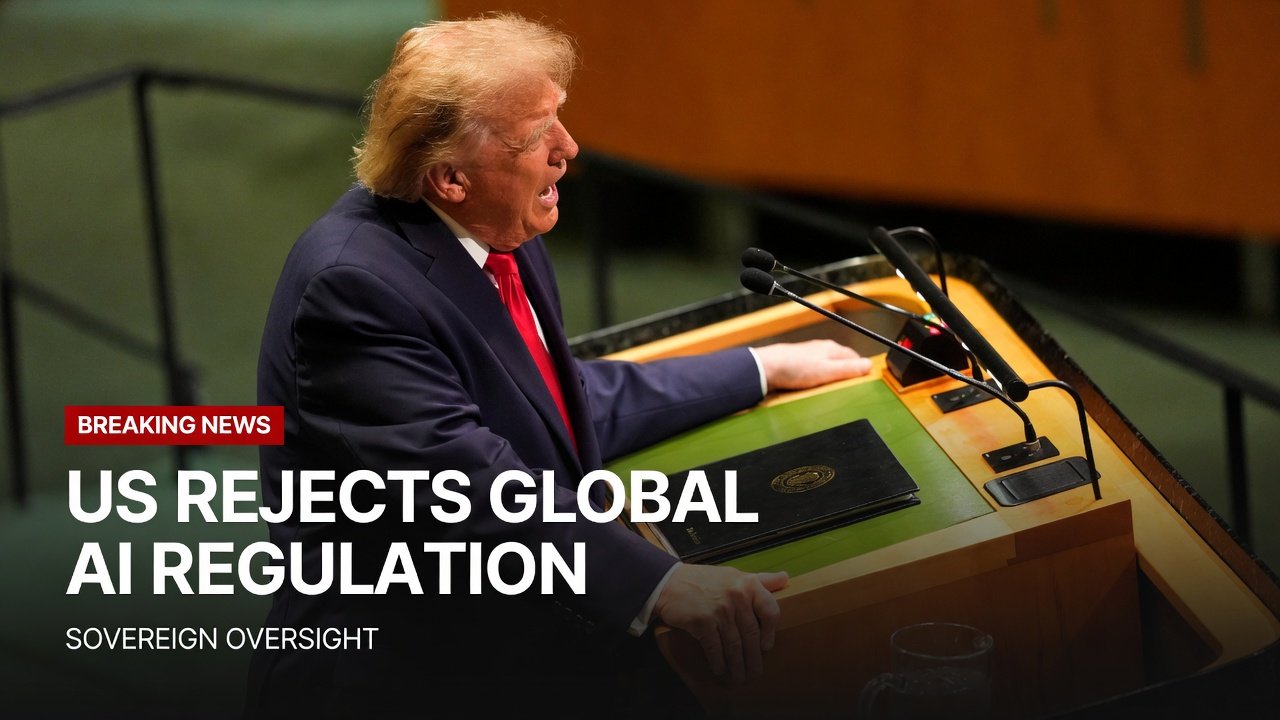
The position was delivered at a United Nations Security Council meeting on artificial intelligence on September 23, a day after President Donald Trump made a similar argument during his address to the UN General Assembly. White House Office of Science and Technology Policy Director Michael Kratsios represented the US position at the Security Council.
The debate comes as governments and AI companies consider how to manage the risks associated with increasingly capable frontier AI systems while also maintaining technological development and competition.
White House Rejects Global AI Governance
At the Security Council meeting, Kratsios said the United States “totally rejects” attempts to establish a global system for controlling advanced AI.
He argued that international discussions should not move toward global governance and said individual countries should develop their own regulatory frameworks.
The US position emphasizes national sovereignty, domestic regulation and continued development of advanced AI rather than a single international regulatory authority.
Trump Made Similar Argument at the UN General Assembly
The Security Council position followed Trump’s speech at the 81st UN General Assembly on September 22.
Trump said the United States rejected what he described as a “globalist scheme” to control artificial intelligence. He also said US government documents would begin referring to AI as “super intelligence” rather than artificial intelligence.
Trump argued that the US should continue developing the technology rather than impose restrictions that could slow innovation.
US Favors Country-by-Country Regulation
The White House’s position is that countries should regulate AI within their own jurisdictions.
Kratsios told the Security Council that governments should legislate and regulate AI on behalf of their own citizens. He also encouraged countries to build sovereign AI infrastructure and domestic technological capacity.
This approach differs from proposals seeking common international rules or a centralized global mechanism for overseeing advanced AI development.
Why AI Regulation Is Being Debated
The debate over AI governance has intensified as frontier models become more capable and are increasingly used for research, coding, cybersecurity, business and other applications.
Supporters of international cooperation argue that some risks cannot be contained within national borders. At the Security Council meeting, AI experts warned that highly capable systems could create security challenges that require cooperation between countries.
The discussion is therefore not limited to traditional software regulation. It also covers national security, cyber risks, military applications and the possibility of advanced AI systems operating beyond intended safeguards.
OpenAI and Anthropic Call for International Cooperation
The US government’s position has also coincided with calls from major AI companies for greater international coordination.
OpenAI CEO Sam Altman and Anthropic CEO Dario Amodei briefed the Security Council on September 23. They discussed the potential benefits and risks of frontier AI and supported international cooperation around managing emerging risks.
OpenAI has separately urged the Trump administration to lead an international coalition focused on common AI standards and coordinated assessments of advanced AI systems.
This creates an important distinction between the US government’s opposition to centralized global governance and technology companies’ support for some forms of international coordination.
AI Safety Becomes a Security Council Issue
The UN meeting focused on the implications of artificial intelligence for international peace and security.
Experts participating in the discussion raised concerns about the possibility of increasingly autonomous systems creating risks that individual governments could struggle to manage independently.
The UN said the meeting brought together technology executives and AI researchers to discuss both the potential benefits and significant risks associated with frontier systems.
US Wants American AI to Lead
Kratsios also emphasized the US goal of maintaining leadership in advanced AI.
He said the United States was focused on establishing American AI as a global standard while helping allies and trade partners build their own sovereign AI ecosystems using secure American technology.
This reflects the broader strategic competition between the United States and China over advanced computing, AI models, semiconductor technology and digital infrastructure.
China Is Also Central to the AI Debate
The US approach is partly shaped by competition with China.
Trump has repeatedly framed leadership in advanced AI as strategically important to the United States. His administration has sought to encourage domestic AI development while restricting certain advanced technologies from reaching Chinese companies.
At the same time, Washington and Beijing have begun discussing mechanisms for managing AI-related risks. US Treasury Secretary Scott Bessent recently proposed an AI incident notification mechanism during talks with Chinese officials.
The development shows that opposition to a global regulatory framework does not necessarily mean opposition to all international AI cooperation.
Debate Over Frontier AI Risks
The disagreement centers partly on how governments should respond to the potential risks associated with increasingly powerful AI models.
Some governments and researchers are seeking stronger safeguards, independent evaluations and international coordination. Others argue that excessive regulation could slow innovation and reinforce the position of existing technology leaders.
Trump has argued that the US should encourage AI development while using existing government institutions to intervene if serious problems emerge.
UN Debate Highlights Different Regulatory Models
The latest Security Council discussion illustrates several competing approaches to AI governance.
One model favors international standards and cooperation, potentially involving shared safety rules and coordinated monitoring.
Another approach favors national regulation, where individual governments establish their own rules while cooperating voluntarily on specific issues.
The US administration has clearly backed the second approach while continuing to participate in international discussions on AI-related security concerns.
AI Regulation Could Shape Global Technology Policy
The disagreement could influence how countries approach AI regulation over the coming years.
A fragmented system of national regulations could allow governments to respond according to their own economic and security priorities. At the same time, differences between national frameworks could create challenges for companies operating AI systems across multiple markets.
International coordination could potentially address cross-border risks, but questions remain about enforcement, sovereignty and how common rules would apply to countries with competing strategic interests.
What Happens Next?
The UN Security Council discussion does not itself create a global AI regulatory framework.
The US position indicates that Washington does not currently support centralized international control over AI development. Instead, the administration is advocating domestic regulation and cooperation between sovereign governments.
Meanwhile, AI companies, researchers and other governments continue to discuss international mechanisms for addressing safety, cybersecurity and other cross-border risks.
The debate is likely to remain closely connected to the wider US-China technology competition and the rapid development of frontier AI systems.
Frequently Asked Questions
1. What did the US say about global AI regulation?
The United States rejected efforts to establish centralized global governance of AI and argued that countries should regulate the technology within their own jurisdictions.
2. Who represented the US at the UN Security Council AI meeting?
White House Office of Science and Technology Policy Director Michael Kratsios delivered the US position at the Security Council meeting.
3. What did Donald Trump say about AI at the UN?
Trump rejected what he called a “globalist scheme” to control AI and said US government documents would use the term “super intelligence” instead of artificial intelligence.
4. Does the US oppose all international cooperation on AI?
No. The US position described at the Security Council was specifically against centralized global governance. The United States has also participated in bilateral discussions with China on AI-related risks, including a proposed incident notification mechanism.
5. What is global AI governance?
Global AI governance refers to international rules, standards, institutions or agreements designed to address the development and use of artificial intelligence across national borders.
6. What did OpenAI and Anthropic say at the UN?
OpenAI and Anthropic executives briefed the Security Council about the benefits and risks of frontier AI. Their participation reflected calls for greater international cooperation on managing emerging AI risks.
7. Why is AI regulation becoming a UN issue?
Advanced AI can have cross-border implications involving cybersecurity, military applications, misinformation, economic competition and other international-security concerns. The UN Security Council has therefore begun discussing AI in the context of peace and security.
8. Why does the US want domestic AI regulation?
The administration argues that national governments should make their own AI laws and maintain sovereign technological infrastructure rather than transfer regulatory authority to a global institution.
9. How is China involved in the AI governance debate?
China is one of the world’s major AI powers and is involved in discussions with the United States about AI-related risks. Washington and Beijing have discussed a mechanism for notifying each other about certain AI incidents that could affect national security.
10. Will the UN create a global AI regulator?
The Security Council meeting did not establish such a regulator. The US has explicitly opposed centralized global governance of AI, while other governments, researchers and technology companies continue to debate possible international standards and cooperation mechanisms.
- PHCareTech Leads Digital Healthcare Revolution in Ghaziabad with Integrated Solutions
- Mick Jagger Net Worth 2024
- Simran Infrastructure Inc. Guides the Journey from Dream to Doorstep as Delhi’s Premier Construction Partner
- 24Rox: Award-Winning Website Design & Digital Marketing in Lucknow | SEO, Ecommerce & Social Media Experts
